Shark Cage Diving Safety In Cape Town: Permits, Cages And The Real Incident Record
Shark cage diving near Cape Town is a permitted, regulated activity with no documented shark-caused guest fatalities in licensed cages. The real risks are mundane: rough seas, cold water and seasickness. Here is the full safety picture, permits to cage steel to incident record.
Short answer
Yes, in the sense that matters: licensed cage diving in South Africa has no documented shark-caused guest fatalities, cages are built to regulated specifications, and operators work under DFFE permits. The genuine risks are sea conditions and seasickness, not the sharks. This roster runs from $126 to $305 per person, and every listing except one offers free cancellation.
Is Shark Cage Diving Safe In Cape Town?
Yes, in the way most people mean the question. Licensed shark cage diving in South Africa has no documented shark-caused guest fatalities, every commercial operator works under government permits, and cages are built to inspected specifications. The risks that actually send guests home unhappy are sea conditions, cold water and seasickness, and those are manageable with preparation rather than courage.
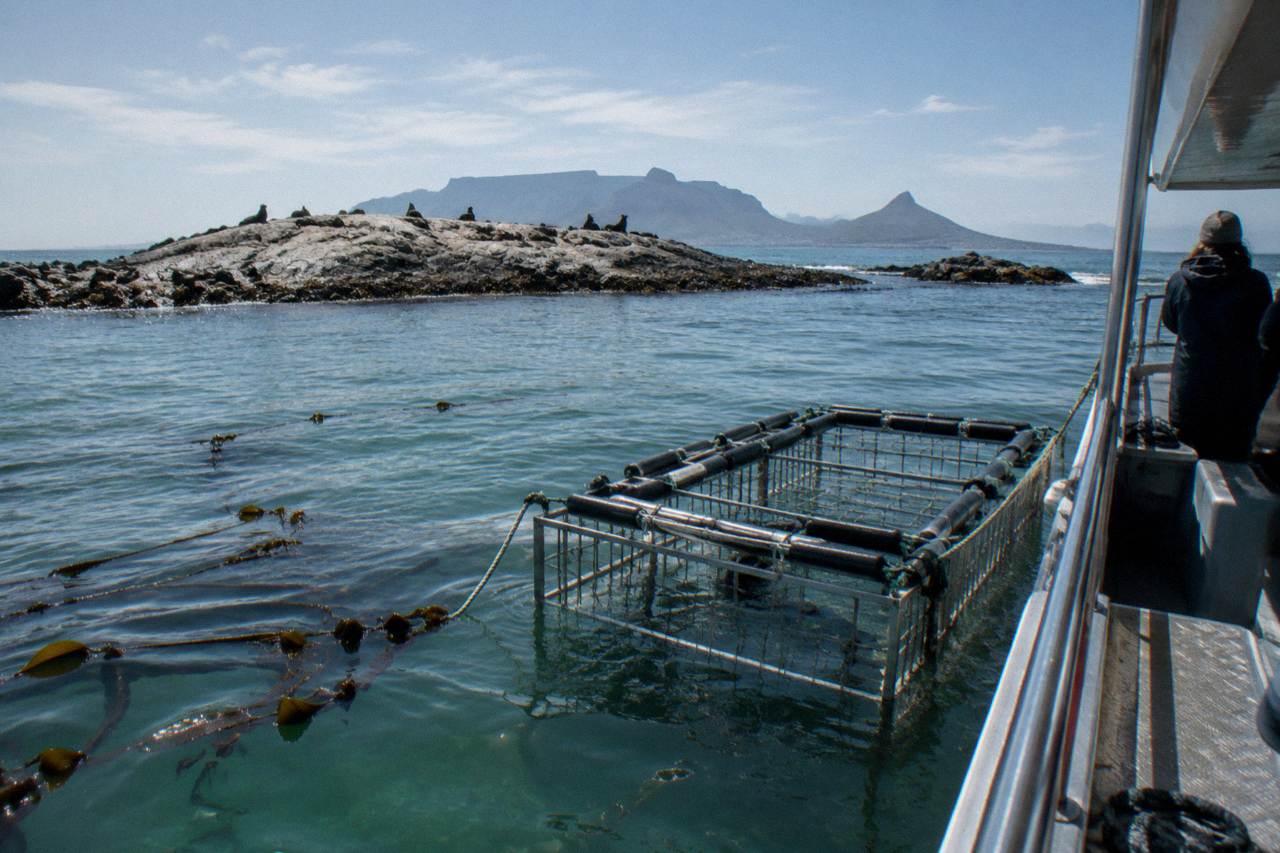
That answer surprises people who arrive with images from documentary films, where a great white throws itself against steel bars. The reality on the water off Gansbaai and Simon's Town is quieter and, honestly, less dramatic. Boats anchor, a cage floats at the surface tethered to the vessel, guests climb in wearing supplied wetsuits, and sharks approach on their own terms. The shark does not know there is a person in the cage and is not attacking it; the operator uses a fish-oil and bait lure to draw the animal past the cage, never to feed it. If your trip launches from Simon's Town, the African penguin colony at Boulders Beach sits just around the corner, and the Boulders Beach penguin entry fee explained covers what a visit costs and how to pair it with a day on the water.
This site, Shark Cage Diving Cape Town, exists because the safety question deserves a straight answer rather than marketing copy. Two things are worth separating from the start. One is the regulated activity itself: permitted boats, built-to-spec cages, crews who run the same route most mornings of the year. The other is the ocean those boats work in, which is cold, sometimes rough, and completely indifferent to whether you booked a tour. Almost every genuine safety conversation about cage diving is really a conversation about the second thing.
There is also a species honesty point that belongs in any safety discussion. Great whites have been largely absent from Gansbaai and False Bay since roughly 2017, when two male orcas nicknamed Port and Starboard began preying on them. What guests in the cage actually see today, on most trips, are bronze whaler (copper) sharks and broadnose sevengill cowsharks. A single sub-adult great white was filmed near Seal Island in False Bay on 23 September 2026, the first sighting there in about eight years, and the marine biologists on record are explicit that this is one sighting, not a population recovery. Nothing on this page should be read as a promise that you will meet a great white.
Who Regulates Shark Cage Diving In South Africa?
Every commercial cage diving operator in the country works under a White Shark Cage Diving permit issued by the Department of Forestry, Fisheries and the Environment, under the NEMBA Threatened or Protected Marine Species Regulations. Permits are allocated by area, capped in number, and carry a code of conduct that bans touching sharks and direct feeding. Boats are additionally subject to SAMSA marine safety rules.
The permit system is the foundation of everything else on this page, and it is stricter than most visitors expect. The historic allocation by area gives Dyer Island and Gansbaai 8 commercial permits, Seal Island in False Bay 3, Seal Island in Mossel Bay 1, Quoin Rock and Quoin Point 2, and Algoa Bay 2, per the consolidated permit regulations. That cap matters for safety in a direct way: a small, named set of licensed operators is monitorable in a way an open market never is. An operator who breaks the code of conduct risks the permit that is the entire business.
The rules themselves are specific. Chumming is permitted only as a natural bait and fish-oil lure to draw a shark close to the cage, never as direct feeding or provisioning, so no shark learns to associate boats with food. Touching sharks is banned outright. Cages must be built to approved specifications with lids, and operations are monitored under DFFE and SAMSA rules, as summarized by the industry's own safety summary. The great white itself has been fully protected in South African waters since 11 April 1991, the first country in the world to protect the species, which means the animal in front of your cage has more legal standing than the boat does, in a sense. Oceans Research covers the protection history and what the evidence supports.
| Permit area | Commercial permits | What it means for a visitor |
|---|---|---|
| Dyer Island / Gansbaai | 8 | The most operators, the most departures, the most reviewed trips |
| Seal Island / False Bay | 3 | A small, fixed operator set departing Simon's Town |
| Seal Island / Mossel Bay | 1 | One permitted operator, no bookable listing on this site |
| Quoin Rock / Quoin Point | 2 | Limited operations, rarely sold to visitors |
| Algoa Bay | 2 | Outside the Cape Town travel radius |
For a reader choosing a trip, the practical translation is simple: book a permitted operator through a listing that names the operator, because the permit holder is the legally accountable party. On this roster, the Gansbaai listings are run by named permit holders such as Marine Dynamics, White Shark Projects, Sharklady Adventures and Cape Shark Adventures, and the False Bay listings by Shark Explorers, Apex Shark Expeditions and African Shark Eco-Charters. If a listing you find elsewhere names no operator at all, that is a reason to keep looking.
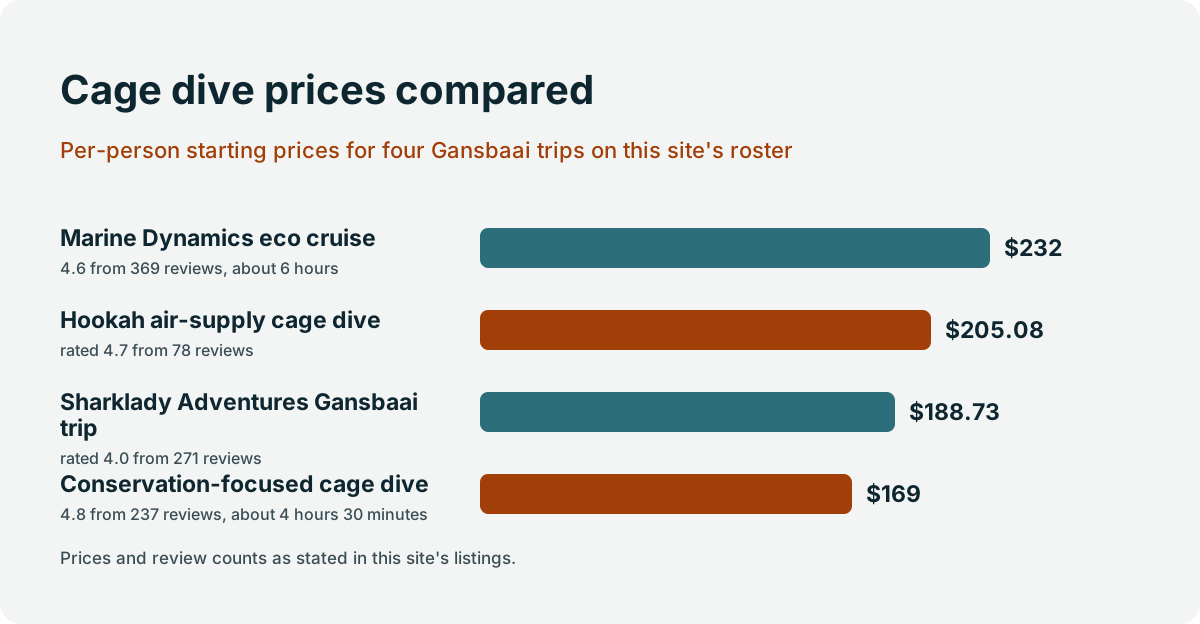
The most-reviewed eco cruise on this roster, run by Marine Dynamics from Kleinbaai with an optional Cape Town transfer, is a good example of the regulated end of the market: 4.6 from 369 reviews, from $232 per person, about 6 hours, free cancellation, and it often sells out. The operator also runs its own marine research and penguin-rescue work through the Dyer Island Conservation Trust, which is the kind of standing a permit system rewards.
How Strong Are The Cages And How Are They Built?
Cages are welded steel frames built to specifications set out in the permit code, with secure lids, float at the surface beside the boat, and are tethered to the vessel. Guests stay in the upper water column, breathing at the surface or through a supplied air line, so there is no depth, no decompression and no scuba certification involved.
The popular image of a cage is a flimsy box that a shark could peel open. The built reality is a heavy steel frame that two crew members winch over the side, with bar spacing sized to keep a large shark's snout out and a person's limbs in, and a lid that closes over the top so nothing can drop in from above. The permit rules require cages built to approved specs with lids, and the same code bans touching the sharks, which protects the animal as much as the guest. Aluminum cages appear at some surface-viewing operations, but the steel-frame surface cage is the standard on the Gansbaai and False Bay rosters.
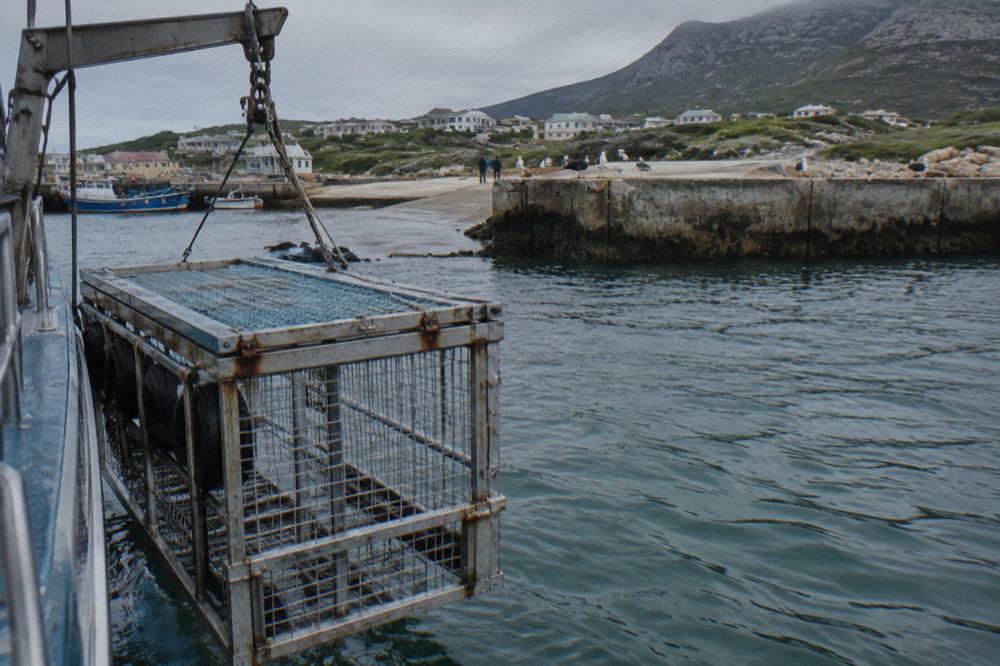
What surprises many first-timers is that the cage never submerges fully and never detaches from the boat. It floats in the top meter or two of the water, tied alongside the hull, and the diver stands on a rail or foothold with head above water between looks. You hold your breath and duck down as the shark passes, or on some trips breathe from a surface-supplied hookah air line. There is no swimming in open water, no free diving, and no situation where the boat and the cage separate. If conditions deteriorate, the cage comes out of the water with you in it.
| Cage element | What the rules and practice require | Why it matters |
|---|---|---|
| Frame | Welded steel, built to approved specifications | Withstands contact without deforming |
| Lid | Secure closure over the top of the cage | Prevents anything entering from above |
| Attachment | Tethered and winched alongside the boat | Cage and divers never separate from the vessel |
| Depth | Surface only, top 1-2 meters of water | No decompression, no certification, no depth risk |
| Air | Breath-hold or surface-supplied hookah line | No tanks, no regulator training needed |
| Shark contact | Touching sharks banned by permit code | Protects both the shark and the diver |
Two roster listings make the air-supply difference explicit. The hookah air-supply cage dive in Gansbaai, from $205.08 per person, upgrades the standard breath-hold setup to a surface-supplied air line, rated 4.7 from 78 reviews. Sharklady Adventures includes a complimentary in-cage air line at no extra cost on its Gansbaai trip, from $188.73 per person, rated 4.0 from 271 reviews. Neither is safer in kind than a breath-hold cage; the air line simply lets you keep your face in the water longer while a shark circles.
If you are weighing a first booking and want a trip that leans into the briefing and the science, the conservation-focused cage dive in Gansbaai is the listing this site features for exactly that reason. It is the highest-rated cage dive on the roster at 4.8 from 237 reviews, from $169 per person, about 4 hours 30 minutes, with breakfast, lunch and snacks included, and free cancellation. You can read more on the conservation-focused cage dive's tour page, and Check availability if a date is firming up.
Has Anyone Died Shark Cage Diving In South Africa?
No paying guest has been documented as killed by a shark inside a licensed cage in South Africa. The one fatal incident in the industry's modern history was the 2008 capsize of a Gansbaai-area boat anchored in heavy seas, in which three tourists drowned; a court ruled it negligence over sea conditions, with no shark involvement and no cage involved.
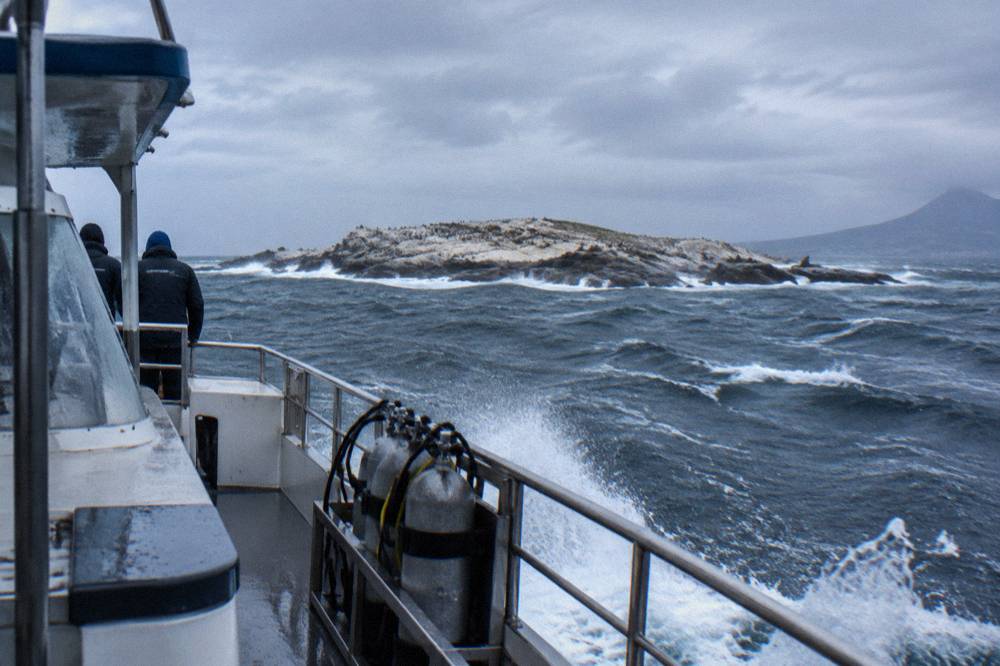
That 2008 incident deserves to be explained honestly rather than buried, because it is the only entry in the real record that a sceptic could point to. A vessel anchored near Dyer Island was hit by a large wave, capsized, and three tourists drowned. The subsequent inquest and civil ruling, preserved in the Western Cape High Court judgment, found the cause was the skipper's decision-making on sea conditions and anchoring, not sharks, not the cage and not the animals' behavior. The industry response was tighter weather judgment and stricter SAMSA oversight, which is why modern trips cancel readily: an operator who calls off your dive because the swell is wrong is the system working, not a failure.
The shark-side record is genuinely clean. No documented shark-caused guest fatalities exist for licensed cage operations, and the injury record for paying guests is essentially empty as well. Sharks approach the cage out of curiosity or in response to the bait lure, circle, and leave. The permit code's ban on provisioning exists precisely to keep it that way: a shark that is fed learns to associate boats with food, and a shark that is merely lured does not. For readers who want the fuller fatality picture across South African shark activity, including why swimmers and surfers face a different risk profile from cage divers, see how many people have died cage diving with sharks.
| Incident category | Documentated record | What it means for a booking |
|---|---|---|
| Shark-caused guest death in a licensed cage | None documented | The core fear has no supporting case |
| Shark-caused guest injury in a licensed cage | None documented in regulated operations | Injuries are not part of the record |
| 2008 Gansbaai-area boat capsize | 3 tourists drowned, ruled sea-condition negligence | Led to stricter weather cancellation practice |
| Other South African shark incidents | Involve swimmers, surfers or poachers, not cage tours | Different activity, different exposure |
The honest framing is this: the activity has one fatal incident in its modern history, and it was a boating accident that better weather rules now guard against. If you want to see how guests describe the felt experience of being in the water with large sharks, whether cage diving in Cape Town is worth it collects the reviewer view, and it is overwhelmingly about the sea and the sharks' beauty rather than fear.
The Marine Dynamics eco cruise, the most-reviewed eco cage dive on this roster at 4.6 from 369 reviews, from $232 per person with free cancellation, is a representative example of how a modern permitted operator runs: a research-oriented operator, biologists on board, and trips that cancel when conditions warrant.
What Is The Most Common Real Risk On A Cage Dive?
Seasickness, and it is not close. Operators and guest reports consistently name it the most common problem on cage diving trips, because boats anchor in open water and rock at the swell for hours. Cold water is second. Shark-related harm does not realistically appear on the list of things that go wrong for guests.
The boat anchors, the swell moves it, and your inner ear objects. That is the whole story of most uncomfortable cage diving trips, and it is why the briefing on every reputable boat spends as long on seasickness as on sharks. The mitigation playbook is unglamorous: take motion-sickness medication the night before and again before boarding, stay on deck in fresh air rather than below, keep your eyes on the horizon, eat a light breakfast rather than none, and tell crew early rather than toughing it out. Ginger remedies help some people. Morning departures tend to run calmer than midday ones, which is one more argument for booking the first launch.
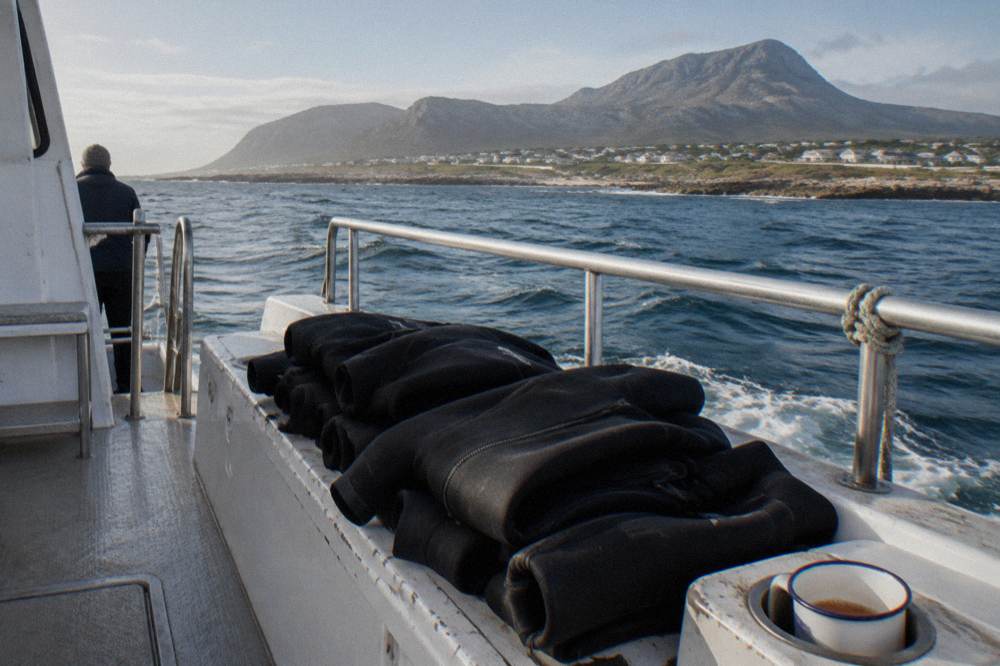
Cold is the second real risk, and it is a function of water temperature rather than courage. Gansbaai and Walker Bay average about 15.8 to 17.4 degrees Celsius from May through September, the peak season, while False Bay around Simon's Town runs about 15.4 to 16.9 degrees Celsius over the same months. A supplied 5mm wetsuit, booties and mask are standard on every roster listing, and they are adequate, but the wind on the ride back is where people get cold. Bring layers, a hat and a towel, and see what to wear for a cage dive for the full kit list. If you know you are prone to nausea, the dedicated seasickness on a shark cage diving boat guide goes deeper than this page can.
| Real risk | How common | Main mitigation |
|---|---|---|
| Seasickness | The most commonly reported issue on trips | Medication in advance, deck air, horizon focus, morning departure |
| Cold water and wind chill | Very common in the May-September peak | Supplied 5mm wetsuit, layers, hat, towel |
| Rough sea conditions | Common in winter; trips cancel when severe | Book with free cancellation, accept the rebooking |
| Disappointment with sightings | Possible; no sighting is ever guaranteed | Know that bronze whalers, not great whites, are the realistic star |
| Shark contact with a guest | No documented cases in licensed cages | Regulated cage design and permit code |
One booking-side risk deserves a plain note. The Apex Shark Expeditions trip from Simon's Town, rated 4.7 from 129 reviews at from $277.05 per person, is the only listing on this roster that is non-refundable, with no free cancellation. Every other listing here offers free cancellation, so if your plans are loose or the weather looks uncertain, that one is the outlier to weigh consciously rather than discover later.
Do You Need To Swim Well Or Hold A Diving Certification?
No scuba certification is required anywhere on this roster, because every cage is a surface cage: you breathe at the surface or from a supplied air line, never from a tank on your back. Basic swimming comfort helps, general fitness is expected, and operators commonly set a minimum age of about 8 to 12 for cage entry with an adult present, while younger children can usually ride the boat as viewers.
The certification question comes up constantly, and the answer is structural rather than reassuring: there is simply no diving in the scuba sense. The cage floats, you float in it, and your head is above water between duck-downs. No depth means no decompression, no tanks, no training. What operators do expect is that you can climb a boat ladder, hold a rail in moving water, and follow instructions in a briefing. Pregnancy and certain medical conditions are commonly flagged on standard waivers, and honesty on the waiver is part of the safety system, not a formality.
| Requirement | Typical operator practice | Notes for families |
|---|---|---|
| Scuba certification | Not required, surface cage only | No course, no card, no prior experience |
| Swimming ability | Basic comfort in water while wearing a wetsuit | Wetsuits provide buoyancy; you are not swimming open water |
| Minimum cage age | Commonly about 8 to 12 with an adult, at divemaster discretion | Policies vary by operator, confirm on the listing |
| Boat viewing age | Often from about 5 to 6 with parental supervision | Younger kids can watch sharks from the deck |
| Fitness | General mobility to board and enter the cage | Climbing a ladder in a wetsuit is the hardest part |
| Medical flags | Pregnancy and some conditions commonly restricted | Declare honestly on the waiver |
Age limits vary by operator and are set at the divemaster's discretion on the day, so treat the numbers above as the typical pattern rather than a rule, and confirm the specific listing's policy before booking with children. The shark cage diving age limit guide covers the family question in full, including which roster listings work best with kids aboard.
Which Operators Have The Strongest Safety Reputations?
On this roster, the strongest signals are review depth plus operator history: Marine Dynamics' listings carry 369 and 622 reviews respectively, White Shark Projects has 451 reviews at 4.7, and the conservation-focused listing is the highest-rated cage dive at 4.8 from 237 reviews. All permit holders work under the same DFFE code, so reputation differences show up in briefing quality and weather judgment rather than in the rules.
Because the permit system sets a common floor, the meaningful comparison between operators is not safety rules but conduct: how early they warn you about seasickness, how readily they cancel in marginal swell, and how honestly they brief you on what you will actually see. Review depth is a decent proxy for all three, since a crew that cancels trips readily will have fewer but more satisfied reviewers, and a crew that overbooks in bad weather generates its own complaint record.
| Listing | Operator | Rating and reviews | From (pp) | Cancellation |
|---|---|---|---|---|
| Conservation-focused cage dive | White Shark Diving Company | 4.8 from 237 | $169 | Free |
| White Shark Projects half-day | White Shark Projects | 4.7 from 451 | $173 | Free |
| Hookah air-supply cage dive | White Shark Diving Company | 4.7 from 78 | $205.08 | Free |
| Marine Dynamics eco cruise | Marine Dynamics | 4.6 from 369 | $232 | Free |
| Marine Dynamics with transport | Marine Dynamics | 4.5 from 622 | $303.54 | Free |
| Shark Zone Gansbaai | Shark Zone | 4.5 from 68 | $126 | Free |
| False Bay open-water dive | Shark Explorers | 5.0 from 37 | $216 | Free |
| Apex Shark Expeditions | Apex | 4.7 from 129 | $277.05 | Non-refundable |
Two small-print points on that table. The False Bay open-water dive by Shark Explorers, 5.0 from 37 reviews, is top-rated among reviewed listings, but with 17 reviews on the parallel Gansbaai listing by Cape Shark Adventures, small pools should be read as strong starts rather than settled verdicts. And the Shark Zone listing at $126 per person is the cheapest on the roster, with the wetsuit and mask included and Cape Town pickup sold as a paid add-on rather than bundled, which is worth checking before you compare its price against a full-day transfer package.
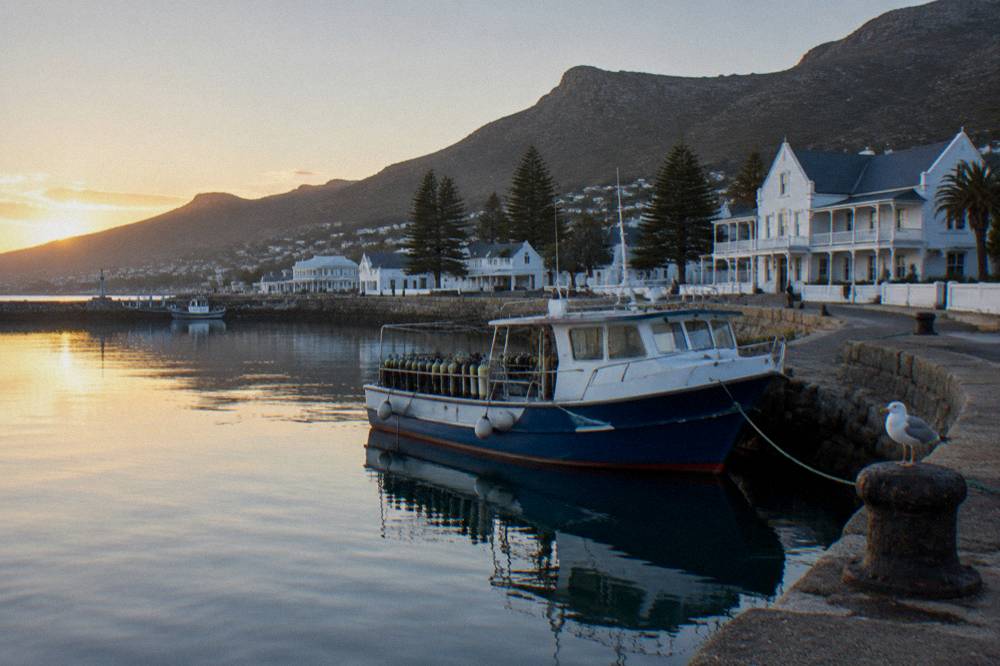
The conservation-focused listing deserves its featured spot here for a safety-adjacent reason: its framing is education-first, with the briefing covering the species decline and the permit rules alongside the practical instructions, and guests who understand why the chum is a lure and not food tend to be calmer and better behaved in the cage. At 4.8 from 237 reviews, from $169 per person with free cancellation, it is also the highest-rated cage dive on the roster.
Two of the most-searched safety questions get their own dedicated pages: are sharks a problem in Cape Town generally, separate from the controlled cage-diving product, and whether you are 100 percent safe in the cage with great whites, which explains what "safe" actually means in a licensed cage.
Common Questions About Shark Cage Diving Safety
Is shark cage diving safe in Cape Town?
Yes, in the sense that matters. Licensed cage diving in South Africa has no documented shark-caused guest fatalities, operators work under DFFE permits with cages built to approved specifications, and the most common real problem guests report is seasickness, not sharks. Book a named operator, take motion-sickness medication in advance, and accept that weather cancellations are part of the safety system.
Has anyone ever been injured in a shark cage?
There are no documented shark-caused guest fatalities in licensed cages in South Africa, and the injury record for paying guests in regulated operations is essentially empty. The one fatal incident in the industry's modern history, the 2008 Gansbaai-area boat capsize in which three tourists drowned, was ruled sea-condition negligence with no shark involvement and no cage involved.
Do you need to be a certified diver to go cage diving?
No. Every cage on this roster is a surface cage: you float in the top meter or two of water, breathing at the surface or from a supplied air line. There is no tank, no depth and no decompression, so no scuba certification is required. Basic swimming comfort and general mobility are what operators actually expect.
What is the most dangerous part of shark cage diving?
The sea, not the shark. Seasickness is the most commonly reported issue because boats anchor and rock in open swell for hours, and cold water is the second real discomfort, with winter water around 15.4 to 17.4 degrees Celsius at the main sites. Medication taken in advance, deck air and supplied 5mm wetsuits handle both.
Are the cages strong enough to hold a great white?
The cages are welded steel frames built to the specifications in the permit code, with secure lids and bar spacing that keeps a shark's snout out and your limbs in, and they are tethered to the boat at all times. The permit code also bans touching sharks and direct feeding, so the animals are lured past the cage rather than provoked. In practice, most guests today share the water with bronze whaler and sevengill sharks rather than great whites.
Can kids do shark cage diving in Cape Town?
Often yes, with limits that vary by operator. Cage entry is commonly set at about 8 to 12 years minimum with an accompanying adult and a signed waiver, at the divemaster's discretion on the day, while younger children can usually join the boat as viewers from about 5 or 6. Confirm the specific listing's policy before booking, since there is no universal rule.