Shark Cage Diving Seasickness: What To Know Before You Board
Seasickness is the single most common problem reported on shark cage diving trips around Cape Town, and it is almost entirely manageable with timing, positioning and the right preparation. Here is what the operators, the trip structures and the guest reviews actually say.
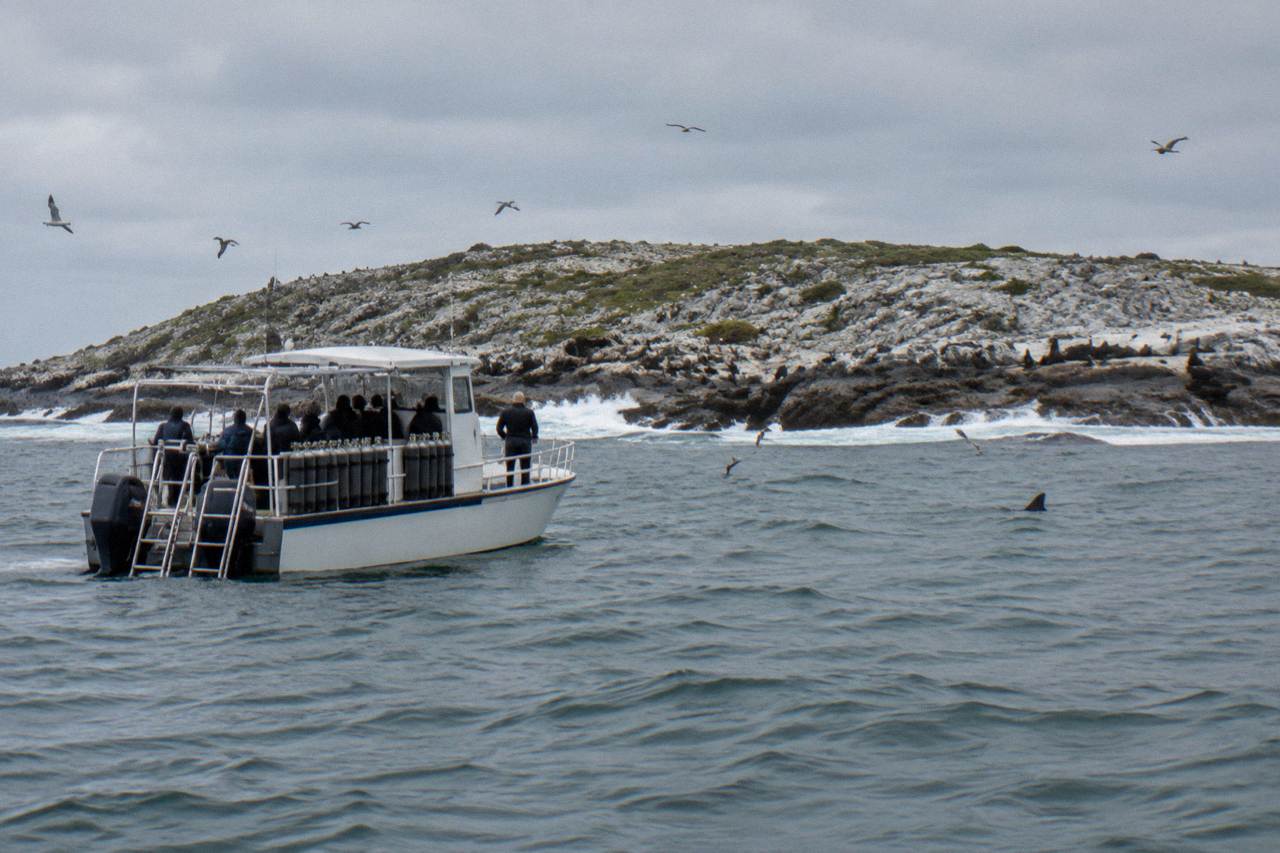
Short answer
Seasickness is the most commonly reported issue on shark cage diving trips, especially on longer full-day Cape Town round trips of 9 to 10 hours. Half-day trips from Kleinbaai run about 3 to 4 hours and carry less risk. Take motion-sickness medication well before boarding, eat lightly, stay on deck with eyes on the horizon, and choose morning departures, which tend to be calmer.
Seasickness, not sharks, is the thing most likely to ruin a cage diving trip. That is not a joke at the industry's expense: across operator briefings, guest reviews and safety write-ups, motion sickness comes up again and again as the most common problem reported on South African shark diving boats, while no shark-caused guest fatality has ever been documented in a licensed cage. The boats anchor, they drift, they roll on the swell, and your inner ear objects. If your stomach does start turning on the day, what actually helps once seasickness hits on the boat walks through crew protocols, medication timing, and the small adjustments that genuinely make a difference.
The good news is that seasickness is also the most preventable problem on the trip. This guide lays out why these particular boats trigger it, which trip formats carry the most risk, a prevention checklist covering medication timing, food, hydration and deck position, and what to do if it hits you anyway. It draws on the operator listings on this site's roster, the verified trip logistics for the Cape Town area, and the practical patterns that repeat across guest reviews.
Why Do Shark Cage Diving Boats Cause Seasickness So Often?
Shark cage diving boats cause seasickness because they anchor or hold station for long periods in open swell, producing the continuous rolling motion that triggers motion sickness, and because the excitement, cold, early starts and pre-dawn travel that surround the trip stack every known aggravating factor on top of it. A moving boat can be anticipated; a stationary boat rocking on swell cannot, and that unpredictability is what confuses the inner ear.
The mechanism is well understood even if the experience is miserable. Motion sickness happens when your eyes, your inner ear and your body's position sense disagree about whether you are moving. Standing in a cabin, staring at a fixed point close by while the boat rolls beneath you, is the classic conflict: your eyes say still, your vestibular system says moving. The conflict builds until nausea arrives.
Cage diving boats make this worse in three specific ways. First, they anchor or hold position near sites like Shark Alley, between Dyer Island and Geyser Rock, which sits roughly 8 to 10km offshore from Gansbaai in open water that carries real swell. Second, the cage itself sits against the boat's side, so guests waiting for their rotation often stand low and close to the waterline, watching a fixed cage rather than the horizon. Third, the trips start early, involve long drives for many guests, and run on adrenaline, all of which lower your resilience before you even step aboard.
The cold adds to it. Water temperatures off Gansbaai average 15.8°C in the July-to-September peak season, and air temperatures on deck match. Cold, tired and slightly dehydrated is the state most people are in when the boat leaves the harbour, and it is the worst possible starting point for a rolling stomach.
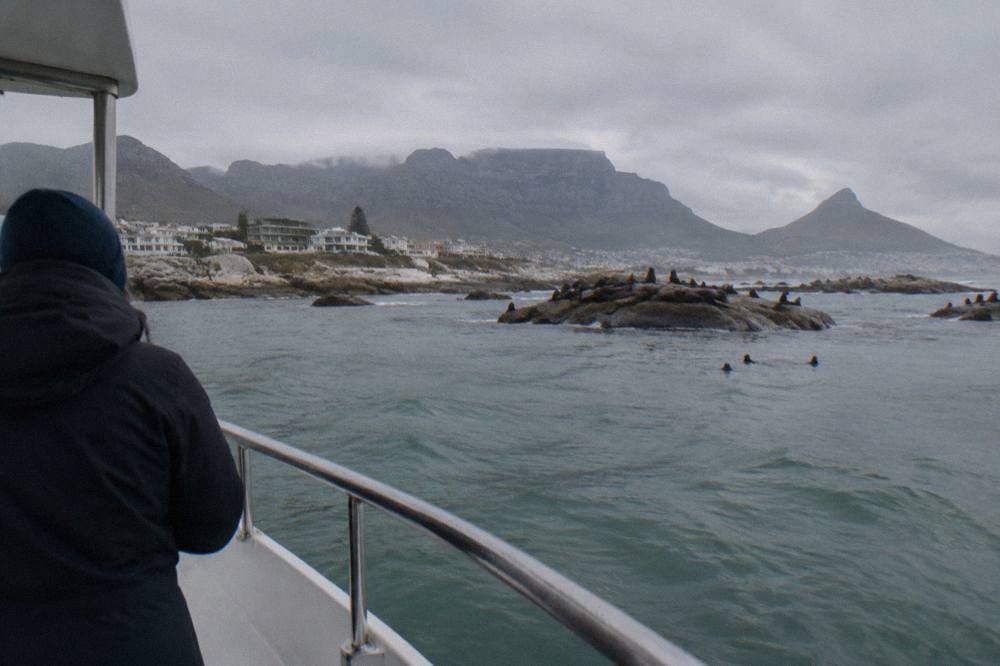
Which Shark Diving Trips Carry The Most Seasickness Risk?
The full-day Cape Town round trips carry the most seasickness risk. They run roughly 9 to 10 hours door to door, including a 2 to 2.5 hour drive each way to Gansbaai before and after 3 to 4 hours on a rolling boat, combining fatigue, early waking and long swell exposure. The half-day trips based at Kleinbaai, around 3 to 4 hours total, are the lower-risk option with less boat time and no pre-dawn drive.
The distinction matters because it is the single biggest lever you control when booking. A trip like Shark Cage Diving with Transport from Cape Town, run by Marine Dynamics, is a 10-hour full-day package with breakfast and light refreshments, rated 4.5 from 622 reviews, the deepest review pool on this roster, and from $303.54 per person. It solves the transport problem completely, but it is a long day, and reviews of these full-day formats frequently mention tired guests and queasy return drives. The same operator's eco cruise from Kleinbaai, by contrast, is about 6 hours and from $232.
At the shorter end, the Kleinbaai-based half-days cut the exposure dramatically. The Cape Shark Adventures viewing trip runs about 3 hours from $171, and White Shark Projects runs a 3-hour half-day from $173 with a continental breakfast and on-board light lunch included. Less time on the water is not a guarantee, but it is the closest thing to one.
| Trip format | Typical total duration | Time on the boat | Relative seasickness risk | Example from this roster |
|---|---|---|---|---|
| Full-day Cape Town round trip | 9 to 10 hours | 3 to 4 hours plus 4 to 5 hours of driving | Highest: fatigue compounds swell | Marine Dynamics with transport, from $303.54 |
| Half-day from Kleinbaai | 3 to 4 hours | 2 to 3 hours | Lower: short exposure, no drive | White Shark Projects half-day, from $173 |
| Simon's Town open-water trip | 3.5 to 4 hours | 2 to 3 hours in False Bay | Moderate: bay can be calmer but open-water cage | Shark Explorers, from $216 |
| Shark and whale combo | 5 to 6 hours | 5 to 6 hours on the water | Higher: longest continuous boat time | Ivanhoe Sea Safaris combo, from $286 |
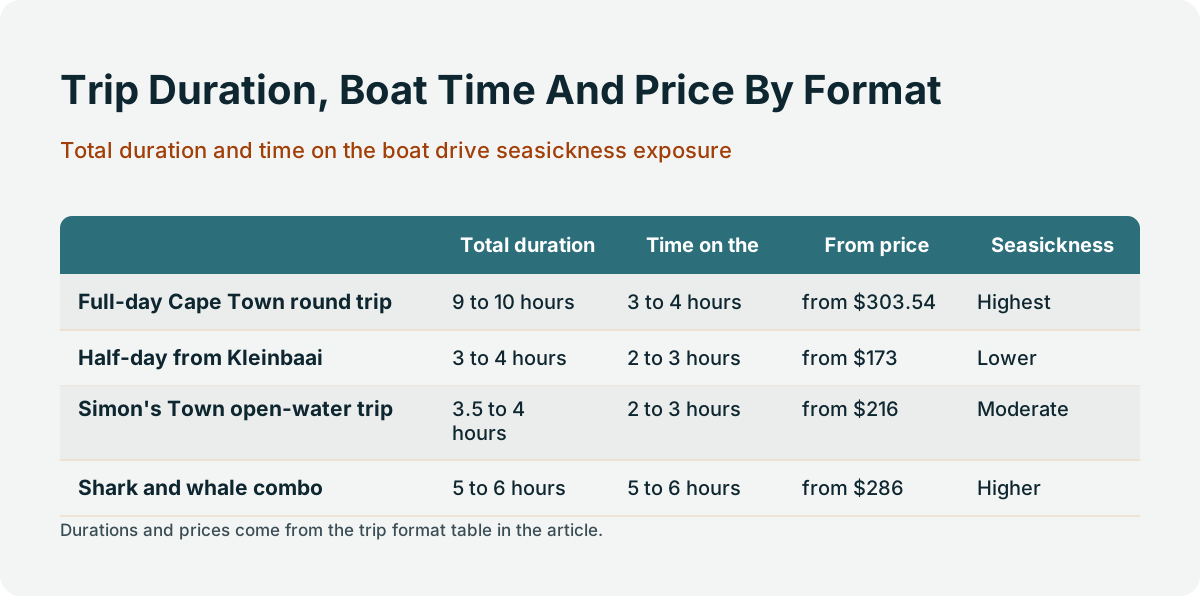
If you already know you are prone to motion sickness, the half-day formats are the rational first choice, and the guide to transport and pickup options covers the self-drive alternative that lets you skip the long transfer entirely. If a full day is the only way the trip fits your itinerary, the rest of this checklist matters more, not less.
The Prevention Checklist: What To Do Before You Board
Effective prevention starts the night before and peaks about an hour before boarding: take motion-sickness medication early enough for it to enter your system, eat a light bland meal rather than nothing, hydrate steadily but not heavily, limit alcohol and coffee, and get real sleep, because medication taken as the boat leaves the harbour is already too late to work. Operators supply the wetsuit, booties and mask, so your preparation is entirely about your body.
Timing is the part people get wrong. Oral motion-sickness medication generally needs to be taken 30 to 60 minutes before departure, and some formulations want more, so the practical rule is to dose before you leave your accommodation, not at the harbour. Once nausea has started, oral medication is far less reliable, which is why the checklist front-loads everything.
Food is the second lever. An empty stomach is not a protected stomach: stomach acid with nothing in it tends to make nausea worse. The pattern that works is a light, bland, low-fat meal a couple of hours before boarding, avoiding anything greasy, heavily spiced or acidic. On the full-day packages that include breakfast, eat modestly rather than making the included meal your biggest of the day.
| When | Action | Why it works |
|---|---|---|
| Night before | Normal sleep, no alcohol | Fatigue and hangover both lower your nausea threshold |
| 2 to 3 hours before boarding | Light, bland, low-fat meal | Settles the stomach without loading it |
| 30 to 60 minutes before boarding | Take motion-sickness medication | Oral doses need time to absorb before the swell starts |
| Morning of | Steady sips of water, limited coffee | Dehydration worsens nausea; coffee and alcohol aggravate it |
| On the drive | Ginger remedies if you use them | Ginger is the most commonly cited natural option in operator advice |
| At the harbour | Layers, sunscreen, hat, towel packed | Cold on deck compounds the problem; operators supply the water gear |
Hydration deserves a line of its own because the early starts sabotage it. Guests wake at 4 or 5am for full-day trips, skip water, drive two hours, then board a boat in the cold. Steady, moderate water intake through the morning is what you want, not a large volume chugged at the dock. The operator advice on what to wear, summarized in the what to wear guide, is part of the same preparation: bring layers for the boat, because operators supply the 5mm wetsuit, booties and mask, not the warm jacket you will want between rotations.
Where To Stand On The Boat And What To Do On Deck
Once aboard, the rules are simple: stay outside on the open deck rather than in a cabin, position yourself near the boat's centre where roll is least, keep your eyes on the horizon rather than on close fixed objects, face the direction of travel when the boat is moving, and stay active on deck helping with lines, because fresh air and a stable visual reference are the two strongest non-drug interventions available.
The centre-of-the-boat point is physics. A boat rotates around a point near its middle, so a person standing amidships moves through the smallest arc, while someone at the bow or stern travels through the largest. On a cage diving boat, that means the area near the wheelhouse is usually calmer than the stern, where the cage hangs and where most of the crowd gathers to watch the sharks.
The eyes rule matters just as much. Watching the cage, the chum line or your phone creates exactly the near-field visual fixation that triggers the conflict described earlier. Looking at the horizon, the distant mountains behind Gansbaai, or the coastline gives your brain a stable reference that agrees with your inner ear. When the boat is underway, facing forward helps further.
Between cage rotations, resist the pull toward the cabin. The warm interior feels inviting in cold weather, but enclosed spaces, engine smells and no visual reference are the classic recipe. Stay on deck, breathe the fresh air, and if you feel the first wave of queasiness, stand up, face the horizon and take slow, controlled breaths. The seasickness blog companion piece goes deeper on the mid-trip rescue steps.
One counterintuitive point from experienced crews: lying down flat in a bunk, when one is available and conditions allow, can genuinely help, because it removes the head movement that drives the vestibular conflict. Sitting hunched in a corner is the worst position; standing at the rail looking out is better; lying flat with eyes closed is often better still.
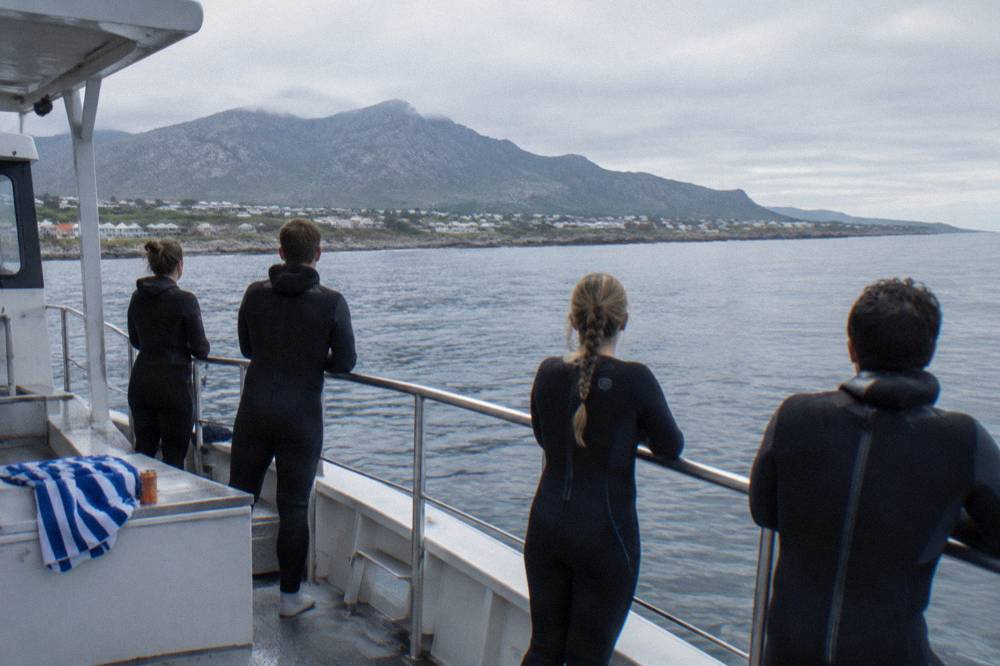
Does Going In The Cage Make Seasickness Better Or Worse?
Going into the cage is usually better for nausea than staying on the boat, because the cage is fixed to the vessel at the waterline where roll is minimal, the cold water tightens your focus, and the adrenaline of a shark approaching reliably suppresses mild nausea, but the transition in and out is the moment guests most often lose their stomach, so enter calmly and never go in already-queasy without telling the crew.
The reports on this are consistent. Guests who felt rough on the crossing frequently describe feeling fine in the cage, then briefly rough again climbing back up the ladder. The explanation is partly the fixed position at the water surface, partly the cold-water shock that resets the nervous system, and partly simple distraction: a bronze whaler shark a metre from the mask occupies the brain fully.
The practical advice follows. If you are mildly queasy and your rotation comes up, take it: the cage is likely your best moment of the trip. Move slowly on the ladder, keep your head steady, and let the crew handle you rather than hauling yourself in a rush. If you are already actively nauseous, tell the crew before entering, because vomiting inside a mask and regulator arrangement is its own problem, and the crew would much rather re-sequence your rotation.
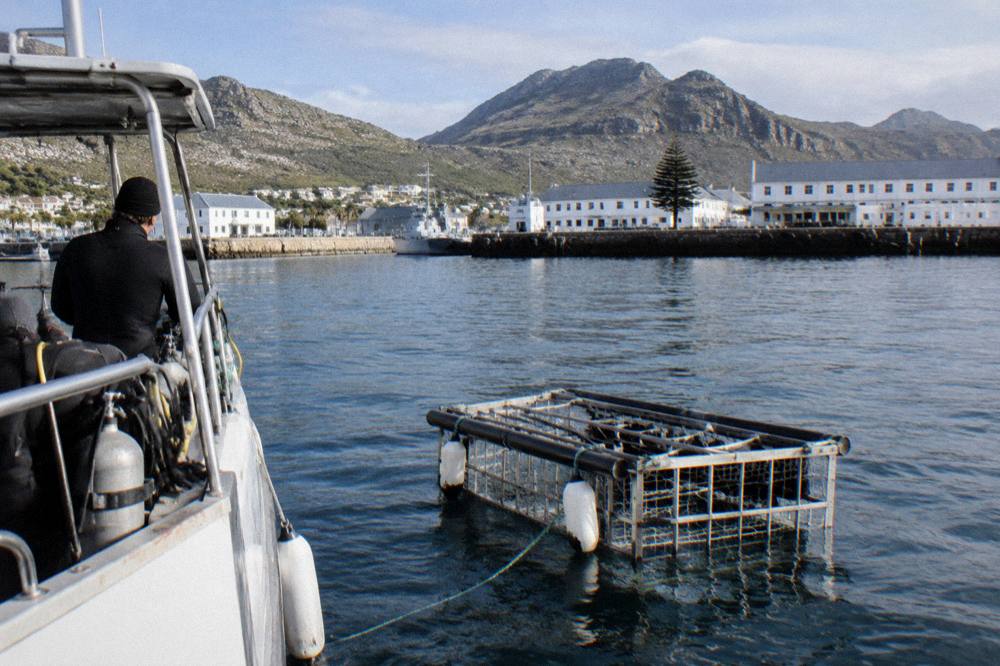
The False Bay open-water trips, like the Shark Explorers trip from Simon's Town, rated 5.0 from 37 reviews and from $216, use a different cage setup in open water, but the same principle holds: the water is calmer than the deck. The Simon's Town trips are covered in detail in the False Bay guide, including the note that this listing often sells out.
Morning Departures, Weather And The Timing Of Your Trip
Morning departures tend to be calmer than afternoon ones, because the wind that builds the chop typically picks up from late morning onward along the Overberg and False Bay coasts, so the standard operator pattern of early launches is not just logistics, it is a sea-state strategy, and booking the first launch of the day is the cheapest seasickness intervention available.
The wind pattern is the underlying reason. The Western Cape's south-westerlies and the local thermal winds build through the day, and the sea state follows. An 8am departure from Kleinbaai often rides a flat morning sea; a midday departure rides the same stretch after four hours of wind have chopped it up. Operators launch early for exactly this reason, and the standard advice across operator pages is that morning trips are calmer.
Season interacts with this. Gansbaai runs year-round, with winter, roughly May to September, the traditional peak for activity and visibility, but winter also brings the bigger swells and the cold that make seasickness more likely. Summer trips are warmer and often flatter but visibility drops with the plankton. The trade-offs by month are laid out in the season guide.
Weather cancellations are part of the system, and they protect you. Operators cancel or reschedule for unsafe sea conditions, and every listing on this roster except one offers free cancellation, so a rough forecast is a reason to rebook, not to endure. The single exception is the Apex Shark Expeditions trip from Simon's Town, from $277.05, which is non-refundable: if you are prone to seasickness, that listing's cancellation terms deserve extra thought before booking.
| Factor | Lower-risk choice | Higher-risk choice |
|---|---|---|
| Departure time | First launch of the day | Late-morning or afternoon departure |
| Season | Summer, warmer and often flatter | Winter, bigger swell and cold |
| Trip format | Half-day from Kleinbaai | Full-day round trip or 5 to 6 hour combo |
| Deck position | Open deck amidships, eyes on horizon | Cabin or stern bench, head down |
| Preparation | Medication 30 to 60 minutes ahead, light meal, sleep | Dosing at the dock, empty stomach, 4am wake after no sleep |
Medication And Remedies Compared
The main options are oral antihistamine-based motion-sickness tablets taken 30 to 60 minutes before departure, acupressure wristbands worn from boarding, ginger in tea or capsule form, and prescription patches applied well in advance, and the honest summary is that the tablets are the most evidence-backed, the patch is the strongest but needs a doctor's input, and wristbands and ginger work for some people and not others.
Talk to a pharmacist or doctor about the tablet choice, because the effective antihistamines cause drowsiness in many people, and a drowsy guest on a full-day trip trades one misery for another. The non-drowsy variants are less effective for many users. This is a planning range, not medical advice: check the packaging and your own pharmacist, and trial any medication on a normal day first.
The patch is the heavy option. It is prescription-only in most places, applied hours to a day before the trip, and it works for most people, but it carries its own side-effect profile, including dry mouth and blurred vision near the eye it sits closest to. For a once-in-a-lifetime trip where you know your stomach, it is worth the doctor's appointment.
Ginger and wristbands sit in the middle: cheap, side-effect free, and genuinely effective for a subset of people. The operator advice commonly mentions ginger, and there is no downside to combining ginger with a tested tablet. What does not work is dosing late, mixing alcohol the night before, or hoping the excitement will carry you.
| Remedy | When to apply | Strength | Main drawback |
|---|---|---|---|
| Oral motion-sickness tablets | 30 to 60 minutes before boarding | Well established for most people | Drowsiness; too late if taken at the dock |
| Prescription patch | Hours to a day before, per doctor's advice | Strongest continuous cover | Side effects; needs prescription |
| Ginger, tea or capsules | Morning of, through the day | Helps many people, cheap | Not reliable for everyone |
| Acupressure wristbands | From boarding onward | Mixed evidence, no side effects | May not be enough alone |
| Nothing, relying on willpower | n/a | n/a | The most commonly reported failure mode |
What To Do If Seasickness Hits You Mid-Trip
If nausea starts on the boat, move to the open deck immediately, stand amidships facing the horizon, breathe slow and steady, sip water, vomit over the leeward rail if it comes to that rather than fighting it into a cabin, and tell the crew, because they handle this on nearly every trip, they can re-sequence your cage rotation, and most people who are sick once recover within the hour and still get their cage time.
The crew point cannot be overstated. Shark diving crews see seasickness on a large share of trips; it is the most common issue reported in the practical literature, and no quantified rate exists because nobody counts. There is no embarrassment in it, and hiding it in a cabin is how a bad hour becomes a bad day. The crew would rather know, because they can time your rotation to your recovery.
Vomiting, if it happens, is best done decisively over the rail on the downwind side, with the crew's guidance. Fighting it prolongs it. Most people feel markedly better immediately after, and the recovery window on a 3-hour trip still leaves time for the cage. On the full-day formats, the return drive is the last risk window, and the drive back to Cape Town is when the fatigue, the adrenaline crash and the motion all settle in, which is a genuine argument for the transport-inclusive packages: being a passenger on the way home beats taking the wheel yourself.
The half-day Kleinbaai trips minimize this whole scenario, which is why they anchor this guide's risk table. The Shark Zone trip from Van Dyks Bay and Kleinbaai, from $126, is the cheapest listing on the roster at about 3 hours, wetsuit and mask included, and a paid Cape Town pickup add-on if you want it. For a fuller picture of the on-the-day experience beyond the seasickness question, the what to expect guide walks through the whole trip structure.
Who Should Think Twice, And Honest Odds
Most people who prepare properly do not get seriously sick: the trips run year-round with high satisfaction ratings, the 4.5 to 4.9 scores across the roster's deepest review pools show seasickness is survivable and often avoidable, but genuinely motion-sensitive travellers should choose the shortest trip format, dose early, take the first launch, and consider whether a 9 to 10 hour full-day package is the right first exposure to open-water swell at all.
The honest framing cuts both ways. Seasickness is the most common problem reported, but the review pools tell you it rarely defines the experience: Marine Dynamics' transport-inclusive full day holds 4.5 from 622 reviews, and White Shark Projects holds 4.7 from 451, ratings that would be impossible if half of each boat spent the day heaving over the rail. Preparation, and the boats' habit of anchoring in relatively sheltered working areas, keep the base rate manageable.
The people who should think hardest are those with a history of severe motion sickness, including migraines triggered by motion, and anyone booking a 5 to 6 hour shark and whale combo, where the continuous boat time is the longest on the roster. For those travellers, the 3-hour Kleinbaai half-days are the sensible first trip, and the full-day Cape Town round trips should be a second trip once you know how your body handles the swell. The Gansbaai guide covers the operator landscape for that shorter format, and this site, Shark Cage Diving Cape Town, exists to make exactly this kind of matched-to-your-body choice easy.
One last practical note: the great white question and the seasickness question are connected only by the trip, not by the sharks. What you will mostly see in the water today at Gansbaai and False Bay are bronze whaler and sevengill sharks, and no shark behaviour affects your stomach. The swell does that on its own.
Common Questions About Shark Cage Diving Seasickness
Is seasickness common on shark cage diving trips?
Yes, it is the most commonly reported issue on these trips, especially in winter when swell is bigger. No quantified rate exists across operators, but crew briefings treat it as routine and the review scores across the roster show it rarely defines the experience.
Should I take seasickness tablets before a shark cage dive?
For most people, yes, and the timing is everything: take oral motion-sickness medication 30 to 60 minutes before boarding, not at the harbour. Once nausea has started, oral doses are far less reliable. Trial your tablet beforehand, since the effective ones cause drowsiness in many people.
Do longer trips make seasickness more likely?
Yes. The full-day Cape Town round trips run 9 to 10 hours with a 2 to 2.5 hour drive each way, and fatigue compounds the swell exposure. The half-day Kleinbaai trips, about 3 to 4 hours, carry clearly less risk for the same core experience.
Where is the best place to stand on the boat to avoid seasickness?
On the open deck, near the boat's centre where roll is least, with your eyes on the horizon. Avoid the cabin, avoid staring at close fixed objects like the cage or your phone, and stay in fresh air rather than sitting low at the stern.
Will going in the cage make me feel worse?
Usually the opposite. The cage sits at the waterline where roll is minimal, cold water sharpens focus, and adrenaline suppresses mild nausea. The vulnerable moment is the ladder transition in and out, so move slowly and tell the crew if you already feel rough.
What if I get seasick during shark cage diving?
Move to the open deck, face the horizon, breathe slowly, and tell the crew: they handle this on nearly every trip and can re-sequence your cage rotation. Most people who are sick once recover within the hour and still get their time in the cage.