What Should You Do If You Get Seasick During Shark Cage Diving?
Seasickness is the most common problem reported on shark cage diving trips out of Gansbaai and Simon's Town. Here is what actually helps once you are already on the boat, from crew protocols to medication timing.
What Should You Do If You Get Seasick During Shark Cage Diving?
Tell the crew immediately, move to fresh air amidships, fix your eyes on the horizon or the distant shoreline, and skip the cabin and the diesel-smelling stern. Seasickness is the most common issue reported on cage diving trips, and crews on licensed Gansbaai and Simon's Town boats handle it every single day. Getting sick is normal, it is not embarrassing, and it almost never ends your trip.
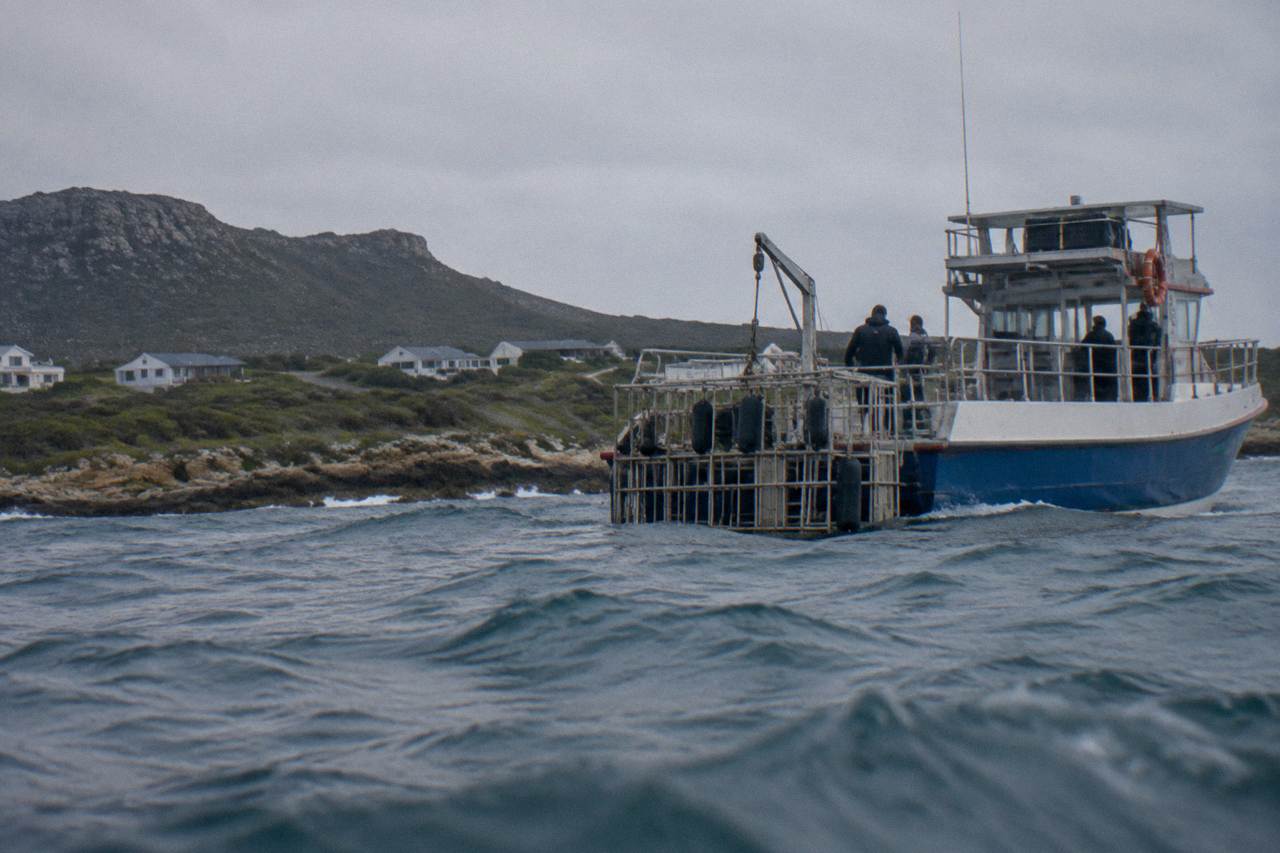
Let's be blunt about the setting. A cage diving boat is not a cruise ship. The typical Gansbaai trip runs 3 to 4 hours on the water, and the boat spends much of that time stationary, anchored near the Dyer Island complex with the swell rolling underneath and the hull rocking on a short, irregular rhythm. That stationary anchor-and-drift pattern is exactly the motion profile that triggers motion sickness in susceptible people. Boats moving forward at speed are easier on the inner ear than boats sitting still and corkscrewing in the swell.
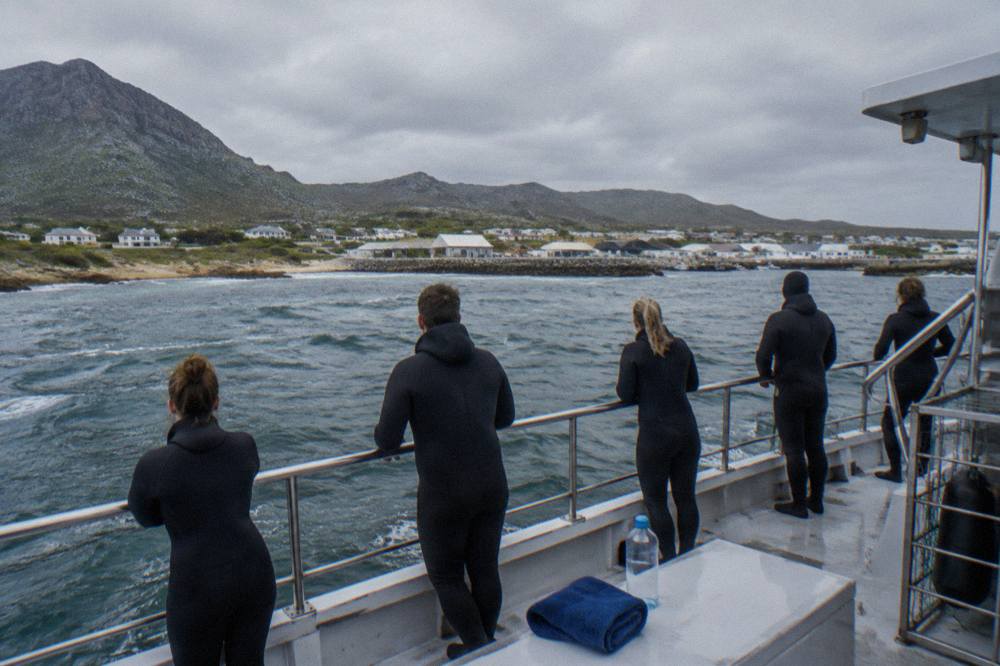
The standard sequence once nausea hits is well established, and crews brief it. Tell a crew member rather than disappearing below deck. Come up into the open air, because the cabin is the worst place on the boat: warm, enclosed, and often smelling of breakfast, chum and diesel. Position yourself amidships and low, where the arc of the boat's rolling is smallest. Pick a fixed point far away, the horizon, the mountains behind Gansbaai, Dyer Island itself, and keep your eyes on it. Do not read, do not look down at your phone, and do not watch the water churning directly alongside the hull.
Breathe slowly through your mouth. Sip water in small amounts rather than gulping. If you are going to be sick, be sick over the leeward rail with the crew's direction; they would far rather hand you a paper bag and a bottle of water than find out later that you suffered in silence in the heads. Operators on licensed trips run safety briefings that cover this, and deckhands carry sick bags as standard kit. You will not be the first guest that morning, and you will not be the last.
There is also a decision to make about the cage. If you feel queasy but stable, going down into the water often helps: the cage hangs from the boat's side, the water damps the rolling, and many guests find the sudden cold of the Atlantic, around 16 to 20 degrees Celsius depending on month, snaps them out of it. If you are actively vomiting or dizzy, stay on deck, recover, and take a later rotation. Boats run cage entries in small groups, so there is usually a second and third chance.
This is a narrower, in-the-moment answer than the full prevention checklist. If you are still planning your trip and want the complete guide to avoiding seasickness in the first place, read the companion piece on seasickness on a shark cage diving boat, which covers medication timing, ginger remedies and how to pick your departure.
If you are comparing which trip to book with a sensitive stomach in mind, these three listings cover the main trade-offs between duration, transport and price:
Why Does The Anchored Cage Boat Trigger Seasickness So Reliably?
Motion sickness happens when your inner ear senses movement your eyes cannot confirm, and an anchored cage boat is close to a worst case for that mismatch. The boat rolls and pitches in the swell without travelling anywhere, so your balance system registers constant motion while the cabin walls appear stationary. Add chum slick smell, engine fumes, nerves and an early start, and the trigger stack gets very tall for many guests.
The mechanics are worth understanding because every remedy works by breaking part of that stack. Your vestibular system in the inner ear detects the rocking. Your eyes, looking at a fixed cabin, report stillness. The brain receives two contradictory motion signals and, roughly speaking, concludes something is wrong, and nausea is the output. This is why horizon-fixing works: it gives your eyes the same motion story your ears are telling, and the conflict shrinks.
The anchoring itself is the aggravating factor. Cage diving boats need to hold position near the sharks, so the engines are off or idling and the boat sits beam-on or bow-on to the swell for hours. Passengers who are fine on the 20 to 60 minute ride out to the site often deteriorate in the first 30 minutes at anchor, which is exactly the pattern trip reports describe. Conditions can be genuinely rough, and winter swell in the Western Cape is no joke. If your stomach has officially vetoed boats, free whale watching from the Hermanus cliff path gets you close to the same marine life with solid ground under your feet.
Smell is the underrated trigger. Chum, a fish-oil and bait-slurry slick, is how licensed operators legally attract sharks; the permit rules allow natural bait and fish-oil lures but never direct feeding. That slick has a smell, and it drifts back over the boat. Add diesel exhaust at the stern and a hot cabin, and the nausea threshold drops sharply. The fix is positional: forward of the engine exhaust, upwind of the chum bucket, in the breeze.
Nerves compound it too. Anticipation, an early alarm, a long drive from Cape Town, and the sight of the cage going over the side all raise adrenaline, and adrenaline sits badly on an empty or overfull stomach. Crews know this, which is why most operators serve a light continental breakfast before departure rather than a heavy cooked one, and why they advise eating something rather than nothing.
One structural fix is to not drive at all. The Marine Dynamics round trip from Cape Town bundles the roughly two-hour transfer each way with breakfast and light refreshments, so you arrive rested instead of wound up from concentrating on the road, and you can sleep on the way home. Check availability if that package suits your dates; it is rated 4.5 from 622 reviews, the deepest review pool on this site's roster, and priced from $303.54 per person with free cancellation.
What Actually Helps Once You Are Already Feeling Sick?
The in-the-moment toolkit is short and physical: fresh air amidships, eyes locked on a distant fixed point, slow mouth breathing, small sips of water, and honest communication with the crew. Vomiting brings real if temporary relief for most people, after which you can often rejoin the trip. Medication taken once you are already sick works poorly or not at all, because oral drugs need time to absorb and your stomach may not cooperate.
Here is the step-by-step version, in the order crews actually walk guests through:
| Step | What To Do | Why It Works |
|---|---|---|
| 1 | Tell a crew member straight away | They can reposition you, hand you a bag, and time your cage rotation around it |
| 2 | Move to open air, mid-boat, low | The rolling arc is smallest near the centre; the cabin is the worst spot |
| 3 | Fix your eyes on the horizon or the shoreline | Re-syncs the visual and inner-ear motion signals causing the conflict |
| 4 | Breathe slowly through your mouth, sip water | Slow breathing calms the nausea reflex; small sips beat big gulps |
| 5 | Avoid the stern, the chum bucket and the cabin | Diesel exhaust, bait smell and heat all lower the nausea threshold |
| 6 | If you vomit, do it over the leeward rail with the crew's help | Relief follows for most people; do not hide in the heads |
| 7 | Reassess after 10 to 15 minutes recovered | Many guests take a later cage rotation and finish the trip |
Two of those steps deserve expansion. The horizon fix is the single most effective free technique, and it works because it directly attacks the sensory conflict rather than masking it. Face the shore if the horizon is featureless; the mountains behind Gansbaai or the Simon's Town coastline give your eyes a stable reference. The moment you look down at your hands, a phone screen or the water alongside, the mismatch returns.
The vomiting question is the one people are most embarrassed about and least need to be. Being sick over the rail is routine on these boats; deckhands on licensed operations handle it with bags, water and zero drama, and most guests report feeling markedly better within minutes afterwards. What crews genuinely cannot manage well is someone who goes below to the toilet, locks the door, and is discovered an hour later having missed the entire trip. The heads on a small boat are also the most motion-sickening compartment on board.
Ginger works at the margin: ginger sweets, ginger ale or ginger capsules have a modest evidence base and are worth trying once symptoms start, since they are safe and fast. Cold water on the back of the neck, a wet cloth on the forehead, and deliberate slow exhalation all take the edge off. Acupressure wristbands are a common guest bring; the evidence is thin but the downside is nil.
What does not work once you are already sick: reading the boat's safety card, staring at your phone, lying flat in the cabin, eating a heavy snack to "settle the stomach", and taking an oral seasickness tablet on board. That last one is worth its own section.
Should You Take Seasickness Medication Before The Trip?
Yes, if you know you are prone, and the timing is everything. Oral motion-sickness tablets need to be absorbed before departure, so the standard advice is to take them the night before and again about an hour before boarding. A tablet swallowed on the rocking boat will not rescue you, and may not absorb at all if you vomit. Check with a pharmacist or doctor for the right drug and dose, especially for children.
The timing table matters more than the brand:
| Approach | When To Use It | Notes |
|---|---|---|
| Oral tablets (e.g. dimenhydrinate-type) | Night before, plus about an hour before boarding | Absorption must happen before the motion starts; drowsiness is a real side effect |
| Ginger (capsules, sweets, ale) | Before and during the trip | Modest effect, safe, can be started on the boat |
| Acupressure wristbands | Put on before departure | Thin evidence, zero downside |
| Prescription patch (e.g. scopolamine-type) | Applied well in advance per the prescription | Requires a doctor or pharmacist; not a same-morning fix |
| Nothing, plan to manage on deck | On the day | Reasonable if you have never been seasick; fresh air and horizon-fixing are the fallback |
A word on drowsiness, because it interacts with the cage decision. First-generation motion-sickness tablets commonly cause sleepiness, and a groggy guest climbing into a cage is not ideal. This is another argument for taking the first dose the night before: it lets the anti-nausea protection carry over while the acute drowsiness peak passes. Discuss the trade-off with a pharmacist, particularly if you are diving rather than viewing.
The non-drug half of prevention happens before you even board: sleep, hydration, no hangover, a light breakfast rather than a cooked one, and honesty with yourself about your history. If you have been seasick on every previous boat, book the morning departure. Operators and trip reports consistently note that morning trips tend to be calmer, both in sea state and in the day's build-up of wind.
If you want the full prevention checklist, including what to eat the night before and how to choose between a morning and afternoon slot, the seasickness planning guide linked earlier in this piece covers it in detail. This article is deliberately about the moment it has already happened.
Does Getting Sick Mean You Miss The Cage?
Usually not. Cage entries run in small rotating groups, so a guest who is sick at the first rotation can almost always take a later one after 15 to 30 minutes of recovery on deck. The water itself often helps: the cage hangs at the surface, the sea damps the rolling, and the cold shock resets the nausea reflex for many people. Crews on licensed trips accommodate sick guests routinely; the only real loss is time, not access.
The rotation system is the structural reason. Boats carry a dozen or more guests and a cage that holds a handful at a time, so entries are organised in successive groups while others watch from the rail. If your name comes up in group one and you are green, tell the divemaster and swap to group three. Operators describe this as an ordinary, everyday request, and divemasters have discretion on the day over who enters and when, which is partly a safety function.
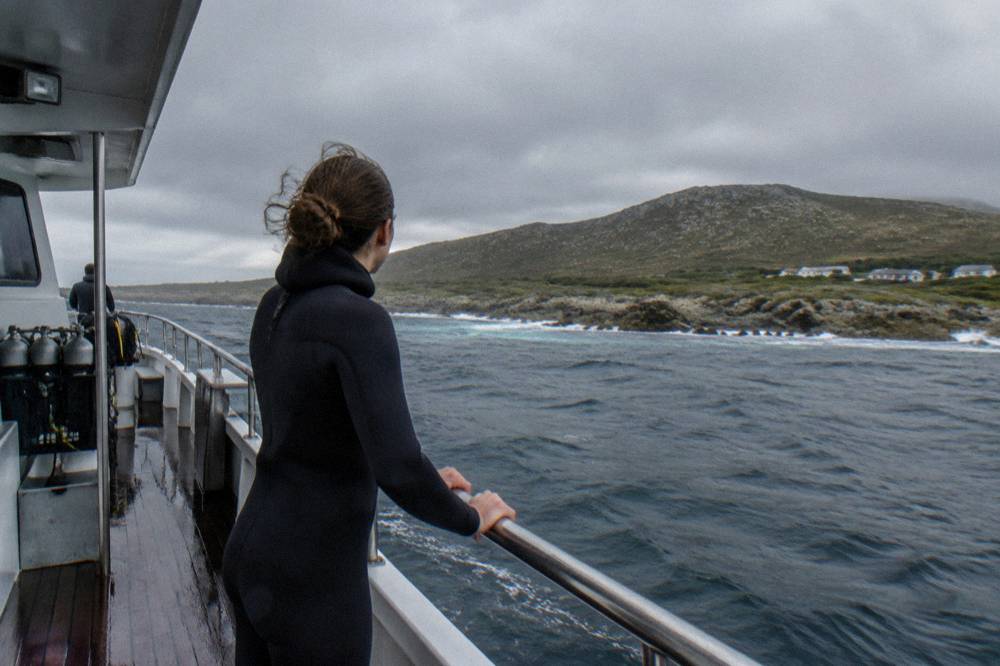
Going into the water is, counterintuitively, one of the better remedies. Inside the cage you are at the waterline, holding the bars, with your head above the surface between breath-hold dives; the violent rolling of the deck is replaced by a slower lift and drop. The 5mm wetsuit operators supply, with booties and mask, means the cold arrives as a squeeze rather than a shock, and cold water on the face is a documented nausea suppressant. Numerous guest reviews describe exactly this arc: sick on deck, recovered in the cage, fine for the rest of the trip.
The honest caveat is about severity. If you are dizzy, unable to stand steadily, or repeatedly vomiting, do not push for a cage entry; a divemaster may decline you and they would be right to. Dizziness plus a surface cage holding onto bars in moving water is a genuine safety combination to avoid. Recover first. The sharks, which today at Gansbaai are mostly bronze whaler and sevengill cowsharks rather than great whites, are not going anywhere in the next half hour.
One operator-specific note on the roster: White Shark Projects runs a half-day trip from Gansbaai rated 4.7 from 451 reviews and priced from $173 per person, about 3 hours in total with a continental breakfast and on-board light lunch included. A shorter total exposure window is a genuine consideration for anyone whose stomach has a hard limit.
Which Trips Are Gentler On A Sensitive Stomach?
Shorter water time and a shorter door-to-door day are the two levers that matter. The half-day Gansbaai listings run about 3 to 3.5 hours on the water versus roughly 6 hours for the eco-cruise format, and Simon's Town departures cut the transfer to about 45 minutes from Cape Town instead of two hours. No operator can promise calm water, but you can choose how many hours of it your stomach has to survive.
The duration spread across this site's roster is real and worth using:
| Trip | Water / Total Time | Rating And Reviews | From (Per Person) | Stomach-Relevant Notes |
|---|---|---|---|---|
| Shark Zone, Gansbaai | About 3 hours | 4.5 from 68 reviews | $126 | Cheapest on the roster; wetsuit and mask included; Cape Town pickup is a paid add-on |
| White Shark Projects, Gansbaai | About 3 hours | 4.7 from 451 reviews | $173 | Continental breakfast and on-board light lunch included |
| Sharklady Adventures, Gansbaai | About 3.5 hours | 4.0 from 271 reviews | $188.73 | Complimentary in-cage air line included |
| African Shark Eco-Charters, Simon's Town | About 3.5 hours | 4.5 from 163 reviews | $251.32 | False Bay departure, about 45 minutes from Cape Town; free cancellation |
| Marine Dynamics eco-cruise, Gansbaai | About 6 hours | 4.6 from 369 reviews | $232 | Longest water window; often sells out; free cancellation |
Read that table as exposure management, not comfort promises. A 3-hour trip is not calmer water than a 6-hour trip on the same day; it is simply fewer hours of it. The Simon's Town option trades the long transfer for a shorter one, which matters if winding coastal roads are part of your problem, though False Bay has its own swell and the same no-guarantees caveat applies to every listing.
Season is the other lever. Gansbaai runs year-round, with peak activity and the best visibility in the cooler April-to-October window; that same window brings the bigger winter swell that makes seasickness more likely. Summer trips are often flatter but with greener, lower-visibility water. There is no month that is both calm and clear; pick which failure mode you would rather have. The best time to go season guide breaks the trade-off down month by month.

For the shortest transfer of all, the award-winning Simon's Town trip runs open-water cage viewing of bronze whaler and, seasonally, other sharks from False Bay, rated 5.0 from 37 reviews and priced from $216 per person with snacks and hot drinks included. It often sells out, and it is a different setting entirely from Gansbaai's boat-based dives.
Common Questions About Seasickness During Shark Cage Diving
What Should You Do if You Get Seasick During Shark Cage Diving?
Tell the crew immediately, get to fresh air amidships, fix your eyes on the horizon or the distant shoreline, breathe slowly and sip water. Do not go into the cabin or the toilet and hide. Most people feel substantially better within 10 to 20 minutes, and because cage entries rotate in small groups, you can usually take a later rotation once you have recovered.
Should I take a seasickness tablet on the boat?
No, it is too late for it to work reliably. Oral motion-sickness tablets need to be absorbed before the motion begins, so the standard advice is a dose the night before and another about an hour before boarding. A tablet swallowed once you are already nauseous may not absorb, especially if you vomit. Ginger sweets or ginger ale are the reasonable on-board fallback.
Does going into the cage make seasickness worse?
For most people the opposite happens. The cage sits at the surface, the water damps the deck's rolling, and the cold water against your face suppresses the nausea reflex. Many guest reviews describe recovering in the cage after being sick on deck. If you are dizzy or repeatedly vomiting, though, stay out of the water and let the divemaster decide; dizziness plus a moving cage is a genuine safety issue.
Will the crew mind if I am sick?
Not at all. Deckhands on licensed Gansbaai and Simon's Town operations carry sick bags as standard kit and handle seasick guests every day. What crews cannot help with is a guest who disappears into the cabin or the heads to suffer privately and misses the whole trip. Say something early and they will reposition you and work around you.
Which trip should I book if I know I get seasick?
Choose the shortest water time and the shortest transfer you can. The half-day Gansbaai listings run about 3 hours on the water, and Simon's Town departures cut the Cape Town transfer to roughly 45 minutes. Book a morning departure, take medication the night before if you are prone, and eat a light breakfast rather than a heavy one. No operator can promise calm conditions on any given day.
Can I get a refund if seasickness cuts my trip short?
Generally no; seasickness is a guest condition, not a cancellation, and wildlife trips run in the conditions of the day. Most listings on this site's roster do offer free cancellation before the trip, so if you wake up already unwell you can usually cancel in advance under the listing's policy. The one exception on the roster is the Apex Shark Expeditions Simon's Town trip, which is non-refundable, so check the cancellation terms before booking if your stomach is a known risk.
The short version: seasickness on a cage diving boat is common, survivable and mostly a timing problem. Manage it on deck with fresh air and a horizon fix, let the crew help, take a later cage rotation, and book the trip shape that limits your exposure in the first place. For the full planning side, including what to eat the night before and how the drive from Cape Town fits in, start with the transport and pickup options guide and the wider coverage on Shark Cage Diving Cape Town. If you are still choosing between trips, these three cover the main duration and price trade-offs: